
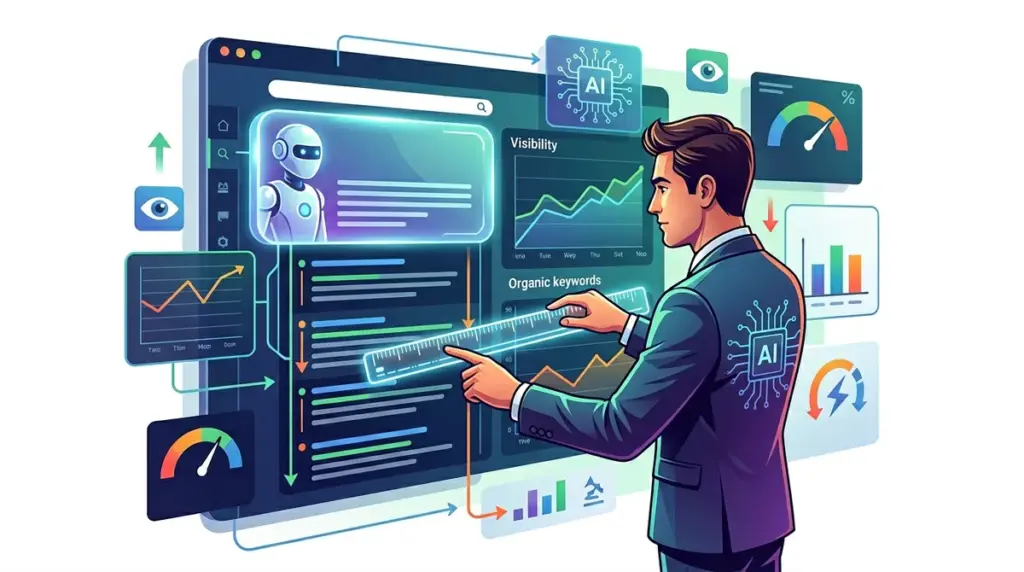
Google’s transition from a list of blue links to a synthesized answer engine has fundamentally altered the value of a "top three" ranking. When an AI Overview (AIO) triggers, it often occupies the top 800 to 1,200 pixels of the viewport, pushing the first organic result below the fold on mobile and significantly down on desktop. For SEO professionals, measuring visibility now requires moving beyond simple integer-based rank tracking to a model that accounts for pixel depth, citation presence, and the displacement of organic real estate.
The Shift from Position to Pixel Depth
Traditional rank tracking treats Position 1 as the ultimate goal, but in an AI-dominated SERP, Position 1 is no longer the highest point of visibility. If an AI Overview appears, it generates a synthesized response that often satisfies the user’s intent without a click. Even if your site is the primary source for that AI response, your organic link may be buried beneath the "Show More" toggle or pushed down by a carousel of alternative sources.
To measure true visibility, you must track Pixel Depth to Organic Start. This metric calculates the exact distance from the top of the search results page to your first organic listing. If this distance exceeds 1,000 pixels, your "Position 1" ranking is effectively invisible to a large percentage of users who will interact solely with the AI-generated text or the cited cards within the overview.
Identifying AI-Triggered Keyword Clusters
Not every keyword triggers an AI Overview. Google tends to favor AIOs for informational queries, "how-to" guides, and complex comparisons where a synthesis of multiple sources adds value. To maintain an accurate visibility index, you must segment your keyword portfolio into three distinct categories:
- AI-Dominant: Keywords where an AIO appears 90% of the time, typically informational or "YMYL" (Your Money Your Life) topics.
- Hybrid SERPs: Keywords where AIOs appear sporadically or are currently in testing, often commercial "best of" queries.
- Traditional SERPs: Keywords where local packs, shopping ads, or standard organic links still dominate, usually high-intent transactional terms.
By segmenting your data this way, you can prevent "visibility noise." A sudden drop in organic CTR on informational terms might not be a ranking failure, but rather a shift in the SERP layout that you cannot control through traditional SEO alone.
Warning: Do not rely on blended CTR models from 2023. AI Overviews significantly cannibalize clicks on "definitional" queries. If your content provides a simple answer that the AI can scrape and display in full, expect a CTR drop of 40-60% even if you remain the top cited source.
Measuring Citation Frequency as the New Position Zero
When an AI Overview appears, the goal shifts from ranking #1 organic to being a cited source within the AI box. Visibility measurement must now include a "Citation Share of Voice" metric. This involves tracking how often your domain appears in the link cards or the expandable "sources" section of the AIO.
Best for: Content publishers and informational sites that rely on top-of-funnel traffic to build brand awareness or ad impressions. If you are cited, you are still "visible," even if the click-through path has changed.
To quantify this, calculate the percentage of your tracked keywords that trigger an AIO where your domain is a cited source. If your organic rank is #2 but you are the primary citation in the AIO, your actual visibility is higher than a competitor who holds rank #1 but is excluded from the AI’s synthesis.
The Impact of the "Show More" Toggle
Google frequently truncates AI Overviews, requiring a user to click "Show More" to see the full response and the associated links. This creates a "hidden" layer of visibility. If your link is only visible after a user expansion, its value is significantly lower than a link visible in the initial summary. When auditing your visibility, distinguish between:
1. Primary Citations: Links visible in the initial AIO snapshot.
2. Secondary Citations: Links revealed only after the "Show More" interaction.
3. Displaced Organic: Standard links appearing below the entire AI module.
A sophisticated visibility report should weight these differently. A primary citation might carry a weight of 1.0, while a displaced organic link at Position 1 might only carry a weight of 0.4 in terms of expected traffic volume.
Adjusting Performance Reporting for Stakeholders
Reporting on keyword visibility to clients or executives requires a change in narrative. If organic traffic is down but keyword rankings are stable, the culprit is likely AI displacement. Use visual SERP snapshots to demonstrate the "pixel theft" occurring at the top of the page.
Focus on Qualified Visibility. This means filtering out keywords where the AI provides a "complete answer" (zero-click searches) and focusing your reporting on keywords where the AI acts as a "bridge" to deeper content. If the AI Overview includes a "Check prices" or "Read full review" call to action that leads to your site, that is a high-value visibility win that traditional rank trackers might misinterpret as a loss of the top organic spot.
Actionable Steps for Visibility Recovery
To regain visibility lost to AI Overviews, you must optimize for the specific elements Google’s Gemini model looks for when generating responses. This includes using structured data (Keyword Position Tool) to clearly define entities and relationships, and ensuring your content uses clear, declarative headings that answer the specific "who, what, and how" of the query.
Monitor your "Ranking vs. Cited" status weekly. If you are ranking in the top 3 but are not cited in the AIO, your content may lack the factual density or structural clarity required for the AI to parse it effectively. Shortening paragraphs, using bulleted lists for technical specs, and removing fluff can often trigger a citation where a 2,000-word "ultimate guide" failed.
Refining Your Visibility Strategy
Measuring visibility in the age of AI requires a move toward Share of Pixels. Stop looking at your average position as a single number and start looking at the percentage of the "above the fold" area your brand occupies across all features—AI Overviews, People Also Ask, and Organic links. The most successful SEOs will be those who stop fighting the AI and start measuring how effectively they can integrate into it.
Frequently Asked Questions
How do AI Overviews affect my keyword ranking data?
AI Overviews do not technically change your organic rank in the source code, but they change the visual position. A site ranking #1 may appear several scrolls down the page. You should use a tool that tracks "Visual Rank" or "Pixel Height" to see the true impact on user behavior.
Can I opt-out of having my content used in AI Overviews?
Currently, there is no specific "no-AI" tag that only blocks AI Overviews without also affecting your ability to appear in standard search results. Using nosnippet or data-nosnippet tags can prevent Google from showing parts of your content, but this will likely hurt your traditional organic visibility as well.
Does being cited in an AI Overview help my SEO?
Yes, it provides high-level brand visibility and can drive traffic, though often at a lower rate than a traditional #1 organic link. However, as users become more accustomed to AI responses, being the "trusted source" within that response will become a critical trust signal for your domain.
Which keywords are most likely to be replaced by AI Overviews?
Informational queries with clear, factual answers are the most vulnerable. "What is," "How does," and "Definition of" type keywords are frequently replaced by full AI responses. Transactional keywords like "buy red sneakers" are less likely to be dominated by AI, as Google still prioritizes Shopping ads and direct organic retailers for these intents.