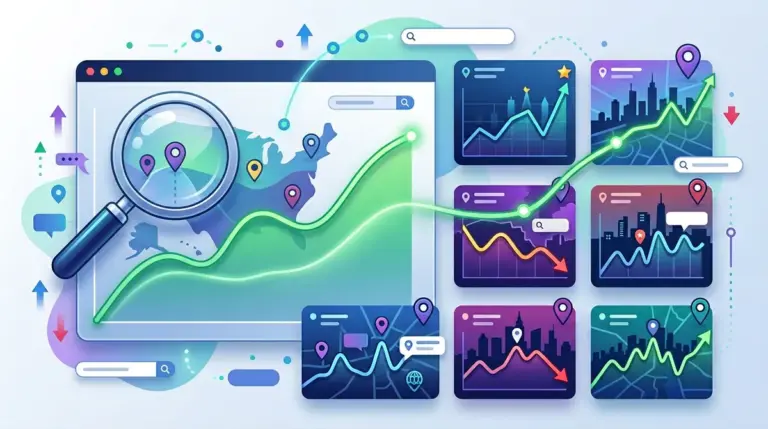


For any business operating with a physical presence or serving distinct local areas, understanding search visibility isn't a national or even regional concern; it's hyper-local. Traditional rank tracking often falls short, providing broad data that masks critical nuances at the city level or within specialized local search interfaces. A dedicated local rank tracker specifically addresses this gap, offering the granular data necessary to assess performance by individual city and within the highly competitive Google Map Pack.
The decision to invest in a local rank tracker hinges on a clear recognition of how local search operates. Customers searching for "plumber near me" or "best coffee shop in [city name]" are typically in immediate need and ready to convert. Their search results are heavily influenced by their physical location, the business's proximity, and its presence in the Map Pack. Without precise tracking for these specific parameters, businesses operate blind, unable to identify true local market opportunities, monitor competitor activity in crucial areas, or accurately measure the impact of local SEO efforts. This is precisely why local businesses can measure ranking visibility more accurately with the right tools.
Understanding the Core Need for Local Rank Tracking
The landscape of search has fundamentally shifted towards localization. Generic, broad keyword rankings offer little utility for a business whose customer base is defined by geographic proximity. A national ranking for "best pizza" is irrelevant if your pizzeria only serves one neighborhood. Local rank tracking provides the necessary precision, allowing businesses to see exactly where they stand in the search results for the specific areas they target.
Traditional rank tracking tools, while valuable for broader SEO strategies, often aggregate data across wide geographical areas. This aggregation can obscure vital local performance metrics. For instance, a business might rank well nationally for a service but be completely invisible in its primary service city due to local competition or unoptimized local listings. Local rank tracking isolates these performance indicators, revealing true visibility where it matters most for local customer acquisition.
Pinpointing Performance: Tracking by City
Granular Geographic Insights
Tracking rankings by city allows businesses to segment their SEO performance geographically, offering a level of detail that is indispensable for multi-location enterprises or service area businesses. This granularity enables a business to:
- Identify specific cities where local SEO efforts are succeeding or failing.
- Uncover new market opportunities by spotting underserved areas where rankings are low but search volume exists.
- Conduct precise competitor analysis within individual city markets, understanding who dominates local search for specific keywords.
- Optimize local landing pages and Google Business Profile listings with city-specific content and targeting.
For a chain of auto repair shops, for example, city-level tracking reveals how each individual branch performs for "tire repair [city name]" or "oil change service [city name]," allowing for tailored SEO strategies per location rather than a one-size-fits-all approach.
Localized Keyword Performance
Keywords often behave differently depending on the searcher's location. A "pizza delivery" search in New York City will yield vastly different results than the same search in a smaller town. Local rank trackers account for this by simulating searches from specific geographic coordinates or postal codes, providing accurate rankings for geo-modified keywords (e.g., "dentist Chicago Loop") and non-geo-modified keywords where local intent is implicit.
Understanding localized keyword performance is crucial for content strategy. It informs decisions on which locations to prioritize for local content creation, how to optimize Google Business Profile categories and services, and where to focus local link building efforts.
Dominating Local Search: Map Pack Tracking
The Map Pack's Commercial Impact
The Google Map Pack, appearing prominently at the top of local search results, is a critical gateway for local businesses. It typically displays the top three relevant businesses, complete with star ratings, addresses, phone numbers, and website links. Securing a spot in the Map Pack directly translates to increased visibility, phone calls, website clicks, and crucially, foot traffic. For many local businesses, the Map Pack is the primary driver of new customer inquiries.
The commercial impact stems from its position of authority and convenience. Users often engage directly with Map Pack listings, making phone calls or requesting directions without ever scrolling further down the search results page. Losing a Map Pack position can therefore have an immediate and measurable negative effect on customer engagement and revenue.
Monitoring Key Map Pack Signals
A robust local rank tracker monitors a range of signals that influence Map Pack visibility. This includes:
- Map Pack Position: Your business's specific ranking within the 3-pack or expanded list.
- Google Business Profile Data: Accuracy and completeness of business name, address, phone number (NAP), categories, and services.
- Review Volume and Sentiment: The number of reviews and average star rating, which significantly impact Map Pack rankings.
- Photos and Posts: Regular updates to your Google Business Profile with relevant photos and posts.
- Local Citations: Consistency of NAP across various online directories.
Tracking these elements provides a comprehensive view of Map Pack health and informs specific optimization tactics to improve and maintain top positions.
Pro Tip: Map Pack rankings are highly dynamic and personalized. A slight change in a user's location or search query can alter results. A reliable local rank tracker should offer daily or near real-time updates to capture these fluctuations, allowing for prompt adjustments to your local SEO strategy before significant visibility is lost.
Beyond Basic Tracking: Advanced Local Metrics
Competitor Local Performance
Understanding your own local rankings is only half the battle. A valuable local rank tracker extends its capabilities to monitor competitor performance within specific cities and Map Packs. This allows businesses to:
- Identify who is outranking them for critical local keywords.
- Analyze competitor Google Business Profile strategies.
- Benchmark their own local SEO efforts against top performers.
- Uncover gaps in competitor strategies that can be exploited.
This competitive intelligence is crucial for refining local SEO tactics and staying ahead in crowded local markets.
Review and Reputation Monitoring
Customer reviews are a cornerstone of local search ranking, especially within the Map Pack. A local rank tracker that integrates review monitoring provides insights into:
- The impact of new reviews on Map Pack position.
- Changes in average star ratings over time.
- Competitor review trends.
This integration highlights the direct link between reputation management and local search visibility, enabling businesses to prioritize review generation and response strategies.
Implementing Local Rank Tracking for Business Growth
Leveraging a local rank tracker effectively means more than just observing numbers; it means translating data into actionable strategies. Regularly analyze city-specific and Map Pack performance trends. If rankings drop in a particular city, investigate recent Google Business Profile changes, new competitor entries, or negative review spikes. If a specific keyword performs exceptionally well in one city but poorly in another, examine the local content and optimization differences. Use the data to inform:
- Targeted content creation for specific city pages.
- Refinements to Google Business Profile categories, services, and attributes.
- Localized link building and citation opportunities.
- Focused efforts on review generation and management.
Continuous monitoring ensures that local SEO efforts remain agile and responsive to the ever-changing local search environment, directly contributing to sustained business growth and customer acquisition.
Frequently Asked Questions
Why can't I just use Google Search Console for local ranks?
Google Search Console provides valuable data on search queries and impressions, but it doesn't offer granular, city-specific ranking positions or detailed Map Pack performance metrics. It also doesn't track competitor rankings, which is crucial for local strategy.
How often should I check my local rankings?
For local businesses, daily or weekly checks are advisable. Local search results, especially the Map Pack, can fluctuate frequently due to user location, personalization, and algorithm updates. Regular monitoring allows for prompt identification and response to changes.
What's the difference between local organic and Map Pack rankings?
Local organic rankings appear in the standard "10 blue links" section of the search results, often below the Map Pack. Map Pack rankings are for the prominent block of 3-4 businesses displayed at the top of local search results, heavily influenced by proximity, relevance, and prominence signals from Google Business Profile.
Can a local rank tracker monitor multiple business locations?
Yes, a key benefit of a dedicated local rank tracker is its ability to track and report on rankings for multiple business locations simultaneously. This is essential for chains, franchises, or multi-branch operations to manage their local SEO across all their sites.