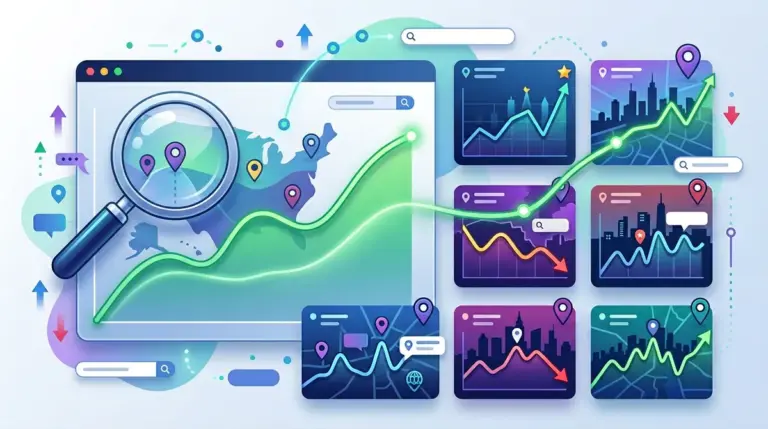


Standard rank tracking is a blunt instrument for a surgical problem. For a local business, a report claiming a "number three average position" for a high-intent keyword is often a mathematical fiction. In the reality of Google’s local algorithm, that business might be number one for a user standing two blocks away and completely invisible to a user three miles north. Measuring visibility accurately requires moving beyond city-level averages and adopting a geofenced, grid-based methodology that accounts for the hyper-local nature of the Map Pack and localized organic results. This hyper-local reality highlights why tracking needs more than national data to reflect true visibility.
The Proximity Trap in Legacy Rank Tracking
Most traditional tracking tools pin a search to a specific zip code or a city "centroid"—the geographic center of a municipality. This creates a data blind spot. Google’s mobile search results are increasingly sensitive to the user's precise latitude and longitude. If your tracking tool only checks from the city center, you are seeing a version of the SERP that may not represent where your actual customers are located.
Best for: Multi-location brands and service-area businesses that need to identify "dead zones" in their local reach.
To fix this, measurement must transition to grid-based tracking. Instead of one data point per city, a grid identifies ranking positions at specific intervals—such as every 500 meters or every mile—across a target service area. This visualization reveals the "ranking radius," the exact point where a competitor’s proximity begins to outweigh your relevance and prominence signals.
Why ZIP Code Level Data Fails Service Area Businesses
Service Area Businesses (SABs) often struggle with visibility because they lack a physical storefront to act as a proximity anchor. When tracking rankings for an SAB, relying on zip codes is misleading because a single zip code can cover 20 square miles. Within that area, the Map Pack will shift dozens of times. Accurate measurement requires tracking from the specific neighborhoods where high-value leads reside, rather than the administrative boundaries of a zip code.
Pro Tip: When analyzing local visibility, always segment your data by "Map Pack" and "Localized Organic." A business can dominate the organic blue links for a "plumber near me" search while being excluded from the Map Pack due to a lack of local citations or poor review velocity. Treating these as a single "ranking" obscures the specific tactical fixes needed.
Differentiating Between Map Pack and Localized Organic Results
Local visibility is binary. You are either competing in the Local Three-Pack or the localized organic results below it. These two ecosystems rely on different ranking factors, and measuring them with the same KPI leads to inefficient spend.
- Map Pack Visibility: Driven by Google Business Profile (GBP) optimization, proximity, and primary category relevance. Measurement should focus on "Share of Voice" within a 3-mile to 5-mile radius of the physical address.
- Localized Organic Visibility: Driven by traditional SEO—backlinks, on-page content, and technical health. This is where you can win searches from users outside your immediate physical proximity.
- Zero-Click Searches: Accurate tracking must account for searches where the user calls or gets directions directly from the SERP without visiting the website.
If your organic rankings are high but your Map Pack rankings are low, your measurement strategy should highlight a "Conversion Gap." This indicates that while your website is authoritative, your local presence lacks the "Prominence" signals—such as review frequency and local link equity—required to break into the Map Pack.
Measuring Visibility Through Weighted Share of Voice
Raw rank numbers are vanity metrics. A rank of #1 for a keyword with 10 monthly searches is less valuable than a rank of #4 for a keyword with 1,000. To measure visibility accurately, local businesses should use a Weighted Share of Voice (SoV) metric. This calculates your visibility by multiplying your ranking position's estimated Click-Through Rate (CTR) by the keyword's local search volume. To truly leverage this data, consider how to use a keyword position tool to refine your local SEO campaigns effectively.
For example, if you hold the #2 position in the Map Pack for "emergency dental" (CTR ~15%) and the volume is 500, your visibility score is 75. If a competitor holds #1 (CTR ~30%), their score is 150. This provides a concrete commercial value to every ranking shift, making it easier to justify SEO spend to stakeholders who care about lead volume rather than abstract positions.
The Impact of Mobile vs. Desktop Parity
Local intent is predominantly mobile. Measuring local rankings from a desktop perspective is a common error that leads to inflated expectations. Mobile SERPs prioritize the Map Pack more aggressively and often include "Near Me" filters that are absent or less prominent on desktop. Accurate measurement requires a mobile-first tracking setup that mimics the device behavior of your specific audience.
Key Differentiator: Mobile tracking accounts for the "User Motion" factor. Google knows when a user is in a vehicle or walking, which can influence the radius of the results shown. While you cannot track every movement, ensuring your rank tracker uses a mobile user agent is the bare minimum for data integrity.
Refining Your Local Measurement Strategy
To achieve a higher level of accuracy, stop looking at your rankings as a list and start looking at them as a heatmap. Begin by setting up a 5x5 or 7x7 grid around your primary location. Monitor the "Average Map Rank" across these points rather than a single point of interest. If you see your visibility shrinking, investigate your recent review velocity and NAP (Name, Address, Phone) consistency across local directories. If your organic visibility is dropping while your Map Pack remains stable, look toward your site's localized content depth and backlink profile. Accuracy in measurement is the only way to ensure your SEO actions are solving the right problems.
Frequently Asked Questions
How often should local rankings be refreshed for accuracy?
For high-competition industries like legal or home services, weekly tracking is necessary to catch competitor aggressive review campaigns or GBP profile changes. For lower-competition niches, bi-weekly or monthly tracking is sufficient to monitor long-term trends without getting lost in daily volatility.
Does the "Near Me" keyword actually need to be tracked?
Yes, but with a caveat. Google automatically appends "near me" intent to many localized searches. You should track both the core keyword (e.g., "HVAC repair") and the "near me" variant. If there is a significant discrepancy in your rank between the two, it usually indicates a lack of local signals on your landing pages.
Can I track rankings for a business without a physical office?
Yes. For Service Area Businesses, you should set your tracking "center" to the middle of your primary service city or the area where you generate the most revenue. Grid tracking is even more vital here to see how far your "authority" reaches from your registered business address, even if that address is hidden on your GBP.
Why do my manual search results differ from my tracking tool?
Personalization and search history. Google tailors results based on your past behavior, your logged-in Google account, and your exact IP address. Professional tracking tools use "clean" browsers and specific coordinates to provide an unbiased view of what a new customer would see.