How to Build Revenue-Focused SEO Reporting from Position Data
Learn how to transform raw position data into actionable revenue forecasts. This guide covers intent segmentation, organic revenue formulas, and how to...
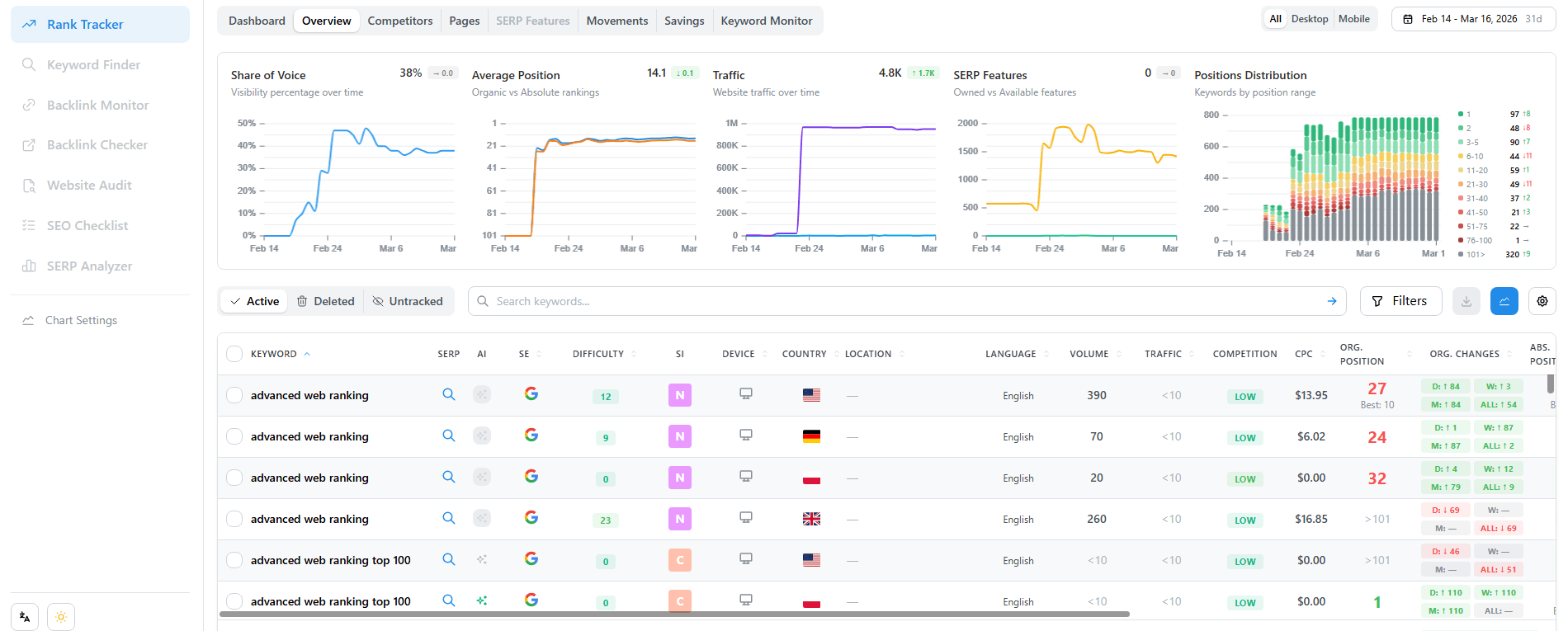
Keyword Position Tool helps you check keyword positions, understand ranking shifts, review SERP placement, and monitor page-level performance without burying the answer. See where terms rank, how positions move, and what deserves action across locations, devices, and priority pages.
The point is not just seeing a number. It is knowing which keyword moved, where it sits in the SERP, which page is ranking, whether the change is local or device-specific, and what that means for next steps.
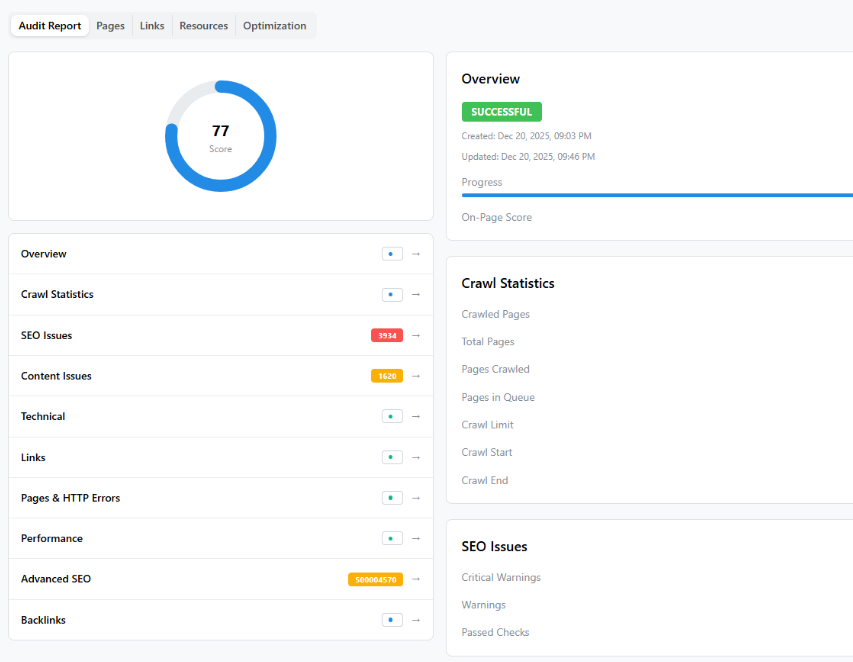
It offers real-time rank tracking, deep technical site audits, and AI search visibility metrics inside a highly intuitive dashboard.
From quick checks to ongoing monitoring, the experience stays fixed on ranking visibility, movement, and page-level interpretation.
Get a fast view of where target keywords stand right now so you can confirm visibility before making changes or reporting performance.
See whether rankings improved, slipped, or held steady so trend direction is obvious instead of buried in a flat list.
Understand how close a term is to stronger visibility by reviewing placement in the results rather than treating every rank equally.
Identify which page is earning the position for each keyword and where mismatches, cannibalization, or weak landing-page alignment may need attention.
Keyword Position Tool is built for people who need a direct answer to a very specific search-performance question: where does this keyword rank, how has that position changed, and which page is responsible for the result? That focus matters. Too many workflows turn a simple ranking question into a maze of disconnected metrics, broad platform views, and vague charts. A strong keyword position tool should keep the core job simple. It should help you check keyword positions quickly, understand the context around each ranking, and monitor movement in a way that supports real SEO decisions.
This is why the product stays centered on keyword positions rather than drifting into unrelated categories. Whether you are an SEO professional managing a large keyword set, an agency reporting across clients, a founder watching commercial terms, or a content team reviewing page-level visibility, the need is the same: a cleaner view of ranking placement and change. You want to know if a keyword moved from page two to page one, if a high-value term slipped on mobile, if a location-specific result changed, or if the wrong page is now ranking. Those are practical questions, and they require a practical keyword position checker.
A keyword position checker is most useful when it removes ambiguity. Position data on its own can be misleading if it is detached from the page ranking, the SERP placement, the device, or the location being checked. A keyword moving from position 11 to position 8 tells one story. The same keyword moving from position 4 to position 8 tells a very different one. A useful keyword ranking position tool helps teams read that difference immediately. It turns ranking checks into something more operational: a way to prioritize updates, validate content changes, review page targeting, and identify where visibility is close enough to improve with focused work.
That is especially important for teams balancing many pages and many intents. A publisher may need to know which editorial page gained visibility for a topic cluster. An ecommerce team may need to check whether product or category pages are holding important non-brand terms. An agency may need a reliable search engine position tool for recurring client reviews. In each case, the value comes from seeing ranking positions clearly and interpreting movement without friction.
When teams say they need to check keyword positions, they rarely mean they just want a static number. They want to understand the quality of the ranking and the context around it. Is the keyword visible enough to drive clicks? Is the ranking stable or drifting? Is the expected page appearing, or has another URL taken over? Is the result stronger on desktop than mobile? Does local search behavior change the picture? A better google keyword position tool should help answer those questions together, because rankings become much more useful when they are connected to real search conditions.
That is where a focused SERP position tool becomes valuable. Instead of treating ranking data as isolated output, it helps teams interpret search placement in a more realistic way. The difference between positions 2, 5, and 9 can change how a team prioritizes updates. The difference between ranking locally in one market and disappearing in another can shift campaign planning. The difference between the right page ranking and the wrong page ranking can affect internal linking, content refreshes, and on-page targeting. A strong keyword position tool keeps those realities attached to the data.
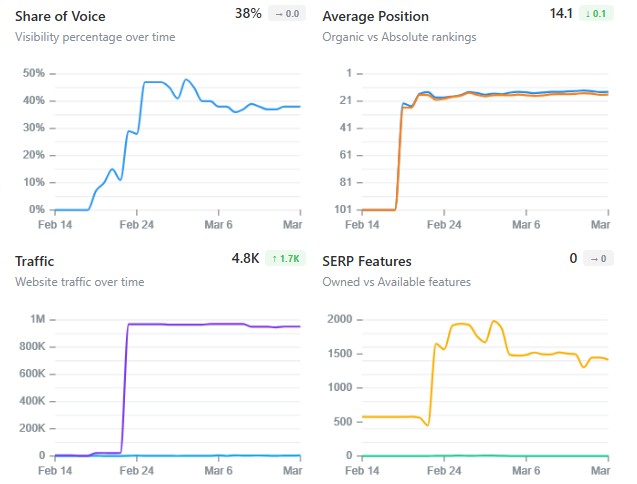
Position visibility is not only about current standing. It is also about movement. A keyword movement checker helps teams see whether changes are isolated, directional, page-specific, or spread across a wider set of terms. That matters because search performance often changes gradually before it becomes obvious in traffic or revenue. If a set of commercial pages starts slipping by a few positions, or if informational pages begin gaining stronger placement for priority terms, the right response depends on spotting the pattern early.
Keyword Position Tool is designed around that need for cleaner monitoring. It supports keyword position tracking in a way that keeps movement readable and useful. Instead of overwhelming teams with broad marketing language, the emphasis stays on ranking direction, page-level visibility, and practical interpretation. That makes it easier to identify when a page update worked, when a competitor shift may have changed the SERP, when local results differ from national expectations, or when a keyword set needs closer review.
A keyword position tracker becomes far more useful when the ranking is tied back to the page earning it. Many SEO decisions are not actually about the keyword alone. They are about the page connected to the keyword. If a priority landing page is not the URL showing in search, that may signal weak targeting, overlap between pages, or a content structure issue. If multiple terms are rising because a single page is improving, that may help justify further optimization on the same asset. If rankings are dropping for one page while others hold steady, the issue may be local to that URL rather than sitewide.
That is why page-level performance belongs at the center of any serious search engine position tool. It gives teams a better way to connect ranking outcomes to actual SEO work. Content teams can evaluate whether a page refresh improved visibility. Agencies can explain ranking changes with more confidence. Site owners can see which pages are carrying important terms and which ones need support. The result is not just better reporting. It is better prioritization.
Search results do not look the same everywhere. Rankings can vary by device, by market, and by local intent. A google keyword position tool that ignores those differences can flatten the picture and lead teams toward the wrong conclusions. For example, a keyword may appear strong on desktop but underperform on mobile, or rank well in one city while missing in another. That is why local and device-based position checks are part of a more practical approach to keyword monitoring.
For agencies handling regional clients, local insight is essential. For ecommerce teams, device differences can reveal where mobile visibility needs attention. For publishers and content teams, local SERP changes may help explain shifts in discovery. A keyword position checker should make those comparisons easier to review so teams can act based on search reality, not assumptions.
The best keyword position tool does not stop at measurement. It helps teams move from observation to action. If a term is sitting just outside stronger click territory, that may point to a page update, title refinement, internal linking improvement, or better alignment with search intent. If a page lost positions across a keyword cluster, that may signal a broader content issue. If another page is now ranking for the same term, the team may need to resolve overlap. Position data becomes strategic when it is easy to read and connected to the page and SERP context behind it.
That is the role of a practical keyword position tracker: not to inflate the workflow, but to sharpen it. SEO professionals can prioritize faster. Marketers can report more clearly. Founders can understand whether search visibility is improving on key terms. Content teams can see which pages deserve updates. Website owners can check keyword positions without needing to wade through unrelated systems or categories.
Keyword Position Tool is meant for users who care about search performance and want a more focused way to read it. It supports the core needs behind a keyword position checker, a SERP position tool, a keyword movement checker, and a search engine position tool in one clear experience: current positions, visible movement, page-level ranking performance, and practical next-step insight. The outcome is straightforward. You spend less time translating ranking data and more time using it.
If your work depends on knowing where keywords stand, how they move, and which pages are earning visibility, a focused keyword position tool makes the process easier to trust. It gives you a cleaner way to check keyword positions, monitor changes over time, and make better decisions from the rankings that matter most.
Teams use Keyword Position Tool when they need position checks that are easier to interpret and easier to act on.
"We needed a keyword position checker that stayed focused on rankings instead of pushing us into a giant platform workflow. This gave us a much clearer read on movement and which pages were actually driving it."
"The page-level visibility has been the biggest win for our content team. We can check keyword positions, see the ranking URL, and make faster update decisions without second-guessing the data."
"For client reporting, the ranking changes are much easier to explain because the movement is tied to actual search placement and page context. It keeps the conversation practical."
"We use it as a search engine position tool for our ecommerce categories and product terms. The local and device-based checks help us catch issues we would have missed in a flatter report."
Quick answers about how Keyword Position Tool helps with keyword checks, monitoring, and ranking interpretation.
Keyword Position Tool is a focused tool for checking keyword positions, reviewing ranking changes, and understanding page-level search visibility.
It is built for SEO professionals, agencies, marketers, founders, content teams, ecommerce teams, publishers, and website owners who need clearer keyword position insight.
Yes. It is designed to help you check keyword positions quickly and see where terms currently stand in search results.
Yes. You can review movement to see which keywords gained, dropped, or held steady across your tracked terms.
Yes. Page-level visibility is part of the workflow so you can connect keyword positions to the right URL.
Yes. The tool supports local and device-based position checks so you can understand how rankings differ by search context.
It is built for keyword position visibility in Google search results, with a focus on practical ranking checks and interpretation.
It stays tightly focused on keyword positions, SERP placement, ranking movement, and page-level performance instead of trying to cover every SEO category.
Yes. Agencies can use it to check keyword positions, monitor changes, and explain ranking performance more clearly to clients.
Because ranking decisions are easier when you know which URL is earning the position. That helps with content updates, page targeting, and resolving keyword overlap.
Technical guides, ranking strategies, and expert guest posts.
Learn how to transform raw position data into actionable revenue forecasts. This guide covers intent segmentation, organic revenue formulas, and how to...
Keyword Position Tool is made for one job: helping teams understand where keywords stand in search and how those positions change. That sounds simple, but in practice it is where many workflows become harder than they need to be. A ranking check should not send you through unrelated dashboards or force you to piece together the story from scattered metrics. You should be able to check keyword positions, review changes, identify the page ranking, and decide what to do next.
That is the core experience here. This is a keyword position tool for users who need search-performance clarity without broad platform sprawl. SEO professionals can use it to review priority terms and confirm movement across important pages. Agencies can use it to communicate ranking changes with more context. Founders and website owners can use it to get direct answers on the terms that matter most. Content and ecommerce teams can use it to see which pages are earning visibility and where rankings may be softening.
When you run a keyword position check, the number matters, but the surrounding context matters just as much. A term at position 3 has a different meaning than a term at position 9. A move from position 14 to 10 may be encouraging, while a drop from 4 to 7 can demand immediate review. Keyword Position Tool is built to make those distinctions easier to read. It works as a keyword position checker that keeps the answer connected to the SERP reality behind it.
That means you are not only checking whether a keyword ranks. You are checking where it sits, how that placement compares over time, and which page is earning the result. This gives teams a more useful way to understand search visibility. Instead of seeing rankings as isolated data points, you see them as part of page performance, content targeting, and overall search presence.
Ranking movement is where position data becomes operational. A keyword movement checker should help you identify what changed and whether the change deserves action. If a page is gaining visibility across a cluster, that may justify more investment. If priority commercial terms are slipping, that may signal a need for content refinement, stronger internal linking, or a closer look at SERP competition. If the wrong page starts ranking, you may be dealing with overlap or targeting drift.
Keyword Position Tool helps teams monitor those changes without losing the thread. It works as a keyword position tracker that emphasizes readable movement rather than generic reporting. Gains, drops, and stable terms become easier to review. That creates a better working rhythm for SEO teams and marketers who need to prioritize efficiently instead of reacting late.
Keyword performance does not live apart from pages. In most cases, the ranking decision you need to make is really a page decision. Should this page be updated? Is the wrong URL showing? Has a category page overtaken a product page? Is an older article ranking for a term that should belong to a newer guide? A useful keyword ranking position tool should bring those questions into view.
By keeping page-level context visible, Keyword Position Tool helps teams work from the actual asset behind the ranking. This is especially valuable for content teams managing large libraries, ecommerce teams balancing category and product intent, and agencies trying to explain why rankings moved. The page connection makes the ranking easier to trust and the next action easier to choose.
Search visibility is not just about whether a term appears somewhere in results. Placement matters. Proximity to the top matters. Device differences matter. Local variation matters. A SERP position tool becomes much more useful when it helps teams see those nuances instead of flattening them into one generic metric. Keyword Position Tool is designed around that practical reading of search performance.
Use it as a google keyword position tool when you need to understand where terms appear in Google results. Use it as a search engine position tool when your team needs a cleaner process for reviewing rankings and movement. Use it as a keyword position checker when you need quick answers. Use it as a keyword position tracker when ongoing monitoring matters. The common thread is clarity: cleaner checks, more visible movement, better page-level understanding, and more grounded SEO decisions.
There is value in staying specific. Teams looking for ranking insight often do not need broader messaging or unrelated feature categories. They need confidence in their position checks. They need to know whether rankings are improving or slipping. They need to understand which pages are winning visibility and whether local or device-based differences are affecting performance. They need a workflow that helps them act.
Keyword Position Tool is built around exactly that need. It gives SEO professionals, marketers, agencies, founders, publishers, and website owners a cleaner way to check keyword positions, monitor changes, understand SERP placement, and review page-level ranking performance. If better search decisions start with better ranking visibility, this is the place to begin.
Built for teams that need a keyword position checker and keyword movement checker that stays practical: where the keyword ranks, which page is showing, what changed, and what to review next.
Desktop keyword position tool for quick keyword rank checks, visibility...
Track where your domain ranks for target keywords, review visibility...
Track where your pages rank in Google, review keyword visibility,...
Check Google keyword rankings fast with Keyword Position Tool. Review...
Track ranking changes over time with a simple keyword movement...
Check keyword positions accurately, review visibility changes, and monitor ranking...
Use a focused keyword position tool to check rankings, monitor movement, and make search decisions with more confidence.